
Calm ADHD Blueprint Review (2026): A Gentle 7-Day Plan to Help Your ADHD Child Become Calmer & More Focused
Calm ADHD Blueprint Review (2026): A Gentle 7-Day Plan to Help Your ADHD Child Become Calmer & More Focused
A Gentle 7-Day Plan to Reduce ADHD Meltdowns and Help Your Child Feel Calmer — Without Harsh Discipline or Relying Only on Medication
If you're exhausted, overwhelmed, and worried about your child's behaviour, you're not alone.
Many parents of ADHD children feel stuck between yelling, guilt, and medication fears.
You're Not Failing.
You're Dealing With Something Most People Don't Understand.
Let's talk about what's actually happening in your home right now. Not judgment. Just reality.
The 6 AM Battle
Your alarm goes off. You take a breath.
Then you hear it—your ADHD child is already awake, already moving, already talking.
Before breakfast is done, there's already been tension.
A meltdown about the shirt. A refusal about teeth brushing. And it's only 6:15 AM.
You haven't even had coffee yet.
The School Calls (Again)
Your phone buzzes. It's the school.
"We need to talk about your child's behavior."
You already know what they're going to say. You hear it weekly (or daily).
Your stomach drops. You feel like a failure. You're thinking:
Am I doing something wrong at home?
Is my child going to struggle forever?
Why can't they just... listen?
What if their teacher thinks I'm a bad parent?
And here's the thing:
You're not a bad parent. Your child isn't bad. Their brain just works differently.
But knowing that doesn't stop the shame spiral.

The Bedtime Nightmare
You've set boundaries. You've tried routines. You've read the parenting books. But 8 PM rolls around and:
They can't settle down
They're still bouncing around at 9:30 PM
You're yelling (and then feeling guilty for yelling)
They're crying
You're exhausted
Nobody wins
And tomorrow you have to do it all again.
The Emotional Overwhelm
It's not just the behavior. It's how big everything feels to them.
A small mistake becomes "I'm stupid"
A friend said something slightly mean and now they hate school
You said "later" and they heard "never"
One bad day means they're a failure at life
Their emotions are cranked to 11 while you're trying to keep yours at a 3.
The Guilt (The Worst Part)
This is the part nobody talks about.
You're lying awake at night replaying the day:
Did I yell too much?
Am I damaging them emotionally?
Should I be on medication? Should they be on medication?
Why can't I stay calm like other parents?
What if they remember me as the parent who was always frustrated?
Am I ruining their childhood?
And the worst part? You love your child fiercely. You're trying everything. And it still feels like you're failing.
You're not failing.
You're dealing with ADHD, which is one of the hardest things to parent.
Your nervous system is responding to constant stress.
Your child's nervous system is dysregulated. And nobody gave you a manual for this.

WHY COMMON SOLUTIONS FAIL ADHD KIDS
You've Probably Tried Everything. And It Didn't Work. Here's Why.
❌ "Just Use Stricter Discipline"
You try stricter rules. More consequences. Clearer boundaries.
But here's what happens:
Your ADHD child doesn't respond to threats the way neurotypical kids do.
Their brain isn't choosing to misbehave. They're dysregulated.
And punishment when a child is dysregulated doesn't teach them—it increases shame and anxiety.
They just become more anxious, more defensive, and the cycle gets worse.
❌ "Punishment Will Teach Them"
The logic sounds good:
Bad behavior = consequence = they learn not to do it.
But ADHD brains don't work that way.
Punishment teaches fear, not behavior change. Your child already feels bad about their behavior.
Adding shame doesn't help them regulate better. It just makes them feel worse about themselves.
❌ "Just Put Them on Medication"
Medication can absolutely help.
It can stabilize focus and reduce impulsivity. But here's what medication doesn't do:
It doesn't teach them how to calm their nervous system
It doesn't build coping skills for stress
It doesn't teach emotional regulation
It doesn't fix sleep or manage emotions during meltdowns
Medication is a tool. But it's not the whole solution.
❌ "Be More Consistent"
You're already consistent. You're probably more consistent than you need to be. You're not the problem.
Your child's nervous system is running in overdrive, and consistency alone can't rewire that.
❌ "They'll Grow Out of It"
Maybe.
But do you really want to wait 5-10 years for maturity to solve this?
While your child struggles with self-esteem, school, friendships, and emotional health?
There's something you can do now.
The Real Problem
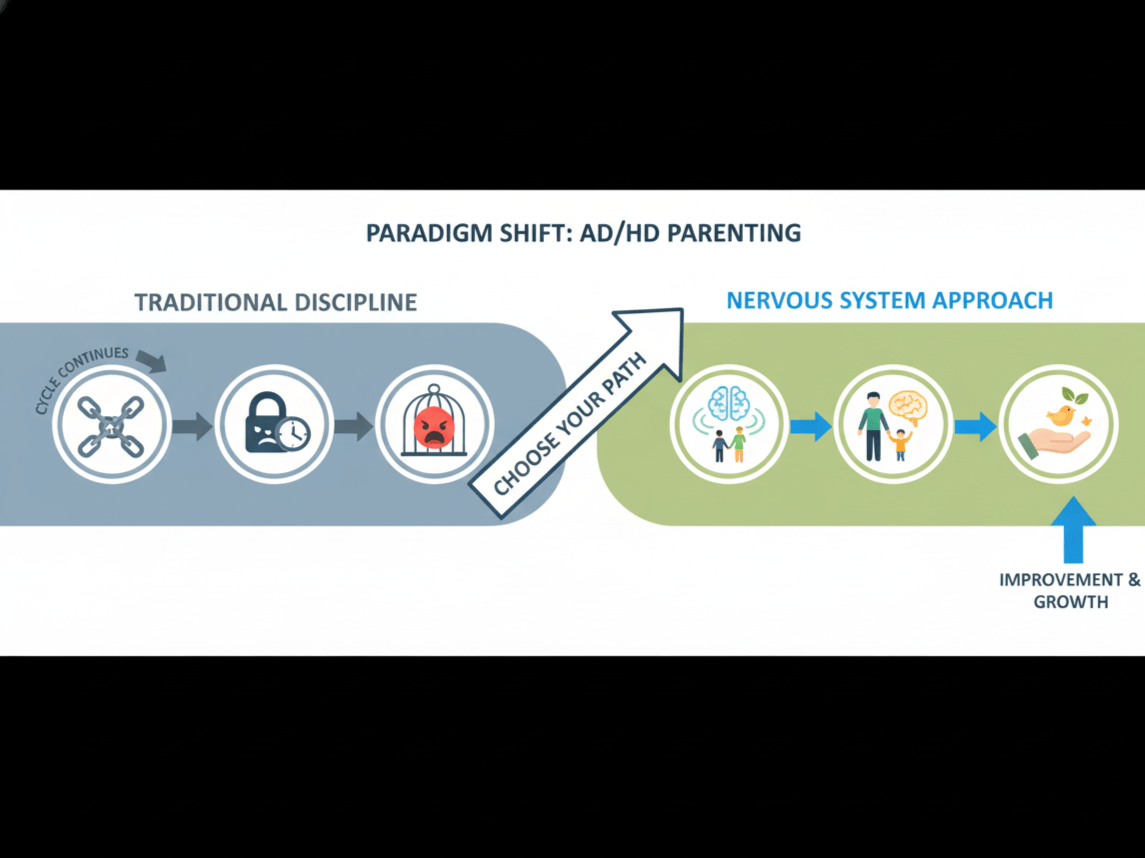
The real problem is that most parenting advice treats ADHD like a behavior problem.
It's not a behavior problem. It's a nervous system problem.
When your child's nervous system is calm and regulated, behavior improves naturally.
When it's dysregulated, no amount of consequences will fix it.
You don't need stricter discipline.
You need to understand how your child's nervous system works—and give them tools to regulate it.
What the Calm ADHD Blueprint Actually Is

The Calm ADHD Blueprint is a parent-guided, 7-day plan designed specifically for parents of ADHD children who are tired of the cycle.
What It's NOT:
A punishment system (no shame, no consequences)
A medication replacement (it works alongside meds)
Generic parenting advice (it's ADHD-specific)
A quick fix for overnight results
Blaming you for how you've been parenting (you've done your best)
What It IS:
A step-by-step guide to understanding your child's ADHD nervous system
Practical strategies you can implement tonight
Designed by someone who understands ADHD neurology
Focused on calm, routine, connection—not punishment
Something that helps you and your child feel less stressed
The Core Philosophy:
Calm nervous system = calm behavior.
Instead of trying to force behavior change through discipline, the Calm ADHD Blueprint teaches you how to help your child's nervous system actually relax.
When they feel safe and regulated, everything else gets easier: focus, emotions, transitions, sleep, relationships.
It's the opposite of what most parenting books teach. And that's why it works for ADHD kids.
Why This Matters:
Your child has ADHD. That's not going to change.
But how they experience ADHD?
How regulated their nervous system is?
How much they struggle with emotions and impulse control?
That can absolutely transform.
This guide shows you how.
Is This Right for Your Family?
This IS a Good Fit If:
✅ Your child has been diagnosed with ADHD (or you strongly suspect it)
✅ Your child struggles with focus, impulse control, or emotional regulation (meltdowns, big reactions, difficulty calming down)
✅ You're exhausted from the constant battles and want a different approach
✅ You want something gentle, not punishment-based that respects your child's neurology
✅ You can commit 10-15 minutes daily to implementing small strategies
✅ You're open to understanding your child's ADHD differently instead of just managing behavior
✅ You want to reduce meltdowns and actual feel-better results (not just survive parenting)
✅ You're willing to work with medication, not against it if your child is on meds
This Is NOT a Good Fit If:
❌ You want overnight miracles (real change takes a week or two to show)
❌ You're looking for a punishment-based system (this is the opposite of that)
❌ You're not willing to change your approach (if you want the same discipline tactics, this won't work)
❌ Your child is in active psychiatric crisis (see a professional first; use this alongside, not instead)
❌ You think ADHD medication is the enemy (this guide complements meds, not replaces them)
❌ You expect your child to "try harder" or "just focus" (this assumes their ADHD is real and neurological, not a character flaw)
❌ You want a system that requires zero effort from you (you're actively implementing changes)
❌ You believe in strict discipline as the solution (ADHD brains don't respond the way neurotypical brains do)

Questions Parents Ask (And Honest Answers)
Is this safe for kids? Will it hurt them?
Yes, it's completely safe.
The Calm ADHD Blueprint focuses on nervous system regulation strategies—breathing patterns, movement, sensory input, routine, connection.
These are gentle, research-based approaches that help kids feel safer. There's nothing harmful.
If anything, reduced stress and better regulation help kids thrive.
What age group is this for?
The guide is written for parents of children roughly age 5-17.
The core principles apply across this range, though strategies may need slight adjustments for younger kids vs. teenagers.
Some parents adapt it for younger kids with great success.
Can I use this if my child is on ADHD medication?
Absolutely.
In fact, this works better alongside medication.
Medication helps regulate dopamine and reduce impulsivity.
This guide teaches your child how to regulate their nervous system and manage emotions.
Together, they're a powerful combination. Keep the medication your child is on; use this guide to teach skills.
What if my child won't cooperate or is resistant?
The guide actually teaches you how to implement these strategies without making it a battle.
You're not announcing "we're trying something new" or asking their permission.
You're subtly restructuring their environment, your responses, and your routines in ways that naturally calm their nervous system.
Kids rarely resist when you're reducing pressure, not adding it.
How long until I see results?
It's fast. Most parents see noticeable improvement by day 3-4.
Is there a refund if it doesn't work for us?
Check the official product page for their refund policy.
Most parenting guides offer 30-day money-back guarantees because every child is different and not everything works for everyone.
You should have protection.
My child has ADHD + anxiety + other stuff. Will this help?
Often, ADHD comes with anxiety, emotional dysregulation, or even trauma.
Calming the nervous system helps all of it.
But if your child has significant mental health issues, this guide should be used alongside therapy, not instead of it.
Use both.
Will my child outgrow ADHD if I do this?
No. ADHD is neurological; they won't "outgrow" it.
But they will develop coping skills and nervous system regulation abilities that let them function dramatically better.
By adulthood, they'll have tools to manage their own ADHD independently. That's the goal.
What's the time commitment?
You don't need hours a day.
Most strategies are 5-15 minutes of intentional parenting.
Some are just small shifts in how you respond or structure the day.
It's efficient, not time-consuming.
You're Not Failing. Your Child Isn't Broken. Calm Can Be Learned.
I know you're exhausted. I know you're scared.
I know you're wondering if you're damaging your child or if they'll ever feel okay.
Here's what's true:
Your child isn't broken. They have ADHD, which means their nervous system works differently.
That's a fact of their neurology, not a reflection of your parenting.
You're not failing. You're dealing with one of the hardest things to parent. You're trying, you're showing up, you're researching solutions.
That's not failure. That's love.
Things can get better. Not perfect. Not overnight. But calmer? More connected? With fewer meltdowns and more joy?
Yes. That's absolutely possible.
The Calm ADHD Blueprint gives you the understanding and the tools to make that happen. Not through punishment or pressure, but through helping your child's nervous system actually feel safe.
In 7 days, you could have:
Fewer meltdowns
Better focus and transitions
A calmer child (and a calmer you)
Understanding of why your child behaves the way they do
Practical strategies that actually work
Your child deserves that. And so do you.

One More Thing
You don't have to have it all figured out.
You don't need to be a perfect parent.
You just need to understand how your child's nervous system works and have a few strategies that actually help.
That's what this guide gives you.
Calmer kids. Less guilt. More joy.
Disclaimer: This review is based on the product description and ADHD parenting science. The Calm ADHD Blueprint is not a substitute for professional psychiatric care, therapy, or medical advice. If your child is in crisis, experiencing severe behavioral issues, or you need mental health support, consult a licensed therapist, pediatrician, or psychiatrist. Medication decisions should be made with your child's doctor.
A Gentle 7-Day Plan to Reduce ADHD Meltdowns and Help Your Child Feel Calmer — Without Harsh Discipline or Relying Only on Medication
If you're exhausted, overwhelmed, and worried about your child's behaviour, you're not alone.
Many parents of ADHD children feel stuck between yelling, guilt, and medication fears.
You're Not Failing.
You're Dealing With Something Most People Don't Understand.
Let's talk about what's actually happening in your home right now. Not judgment. Just reality.
The 6 AM Battle
Your alarm goes off. You take a breath.
Then you hear it—your ADHD child is already awake, already moving, already talking.
Before breakfast is done, there's already been tension.
A meltdown about the shirt. A refusal about teeth brushing. And it's only 6:15 AM.
You haven't even had coffee yet.
The School Calls (Again)
Your phone buzzes. It's the school.
"We need to talk about your child's behavior."
You already know what they're going to say. You hear it weekly (or daily).
Your stomach drops. You feel like a failure. You're thinking:
Am I doing something wrong at home?
Is my child going to struggle forever?
Why can't they just... listen?
What if their teacher thinks I'm a bad parent?
And here's the thing:
You're not a bad parent. Your child isn't bad. Their brain just works differently.
But knowing that doesn't stop the shame spiral.
The Bedtime Nightmare
You've set boundaries. You've tried routines. You've read the parenting books. But 8 PM rolls around and:
They can't settle down
They're still bouncing around at 9:30 PM
You're yelling (and then feeling guilty for yelling)
They're crying
You're exhausted
Nobody wins
And tomorrow you have to do it all again.
The Emotional Overwhelm
It's not just the behavior. It's how big everything feels to them.
A small mistake becomes "I'm stupid"
A friend said something slightly mean and now they hate school
You said "later" and they heard "never"
One bad day means they're a failure at life
Their emotions are cranked to 11 while you're trying to keep yours at a 3.
The Guilt (The Worst Part)
This is the part nobody talks about.
You're lying awake at night replaying the day:
Did I yell too much?
Am I damaging them emotionally?
Should I be on medication? Should they be on medication?
Why can't I stay calm like other parents?
What if they remember me as the parent who was always frustrated?
Am I ruining their childhood?
And the worst part? You love your child fiercely. You're trying everything. And it still feels like you're failing.
You're not failing.
You're dealing with ADHD, which is one of the hardest things to parent.
Your nervous system is responding to constant stress.
Your child's nervous system is dysregulated. And nobody gave you a manual for this.
WHY COMMON SOLUTIONS FAIL ADHD KIDS
You've Probably Tried Everything. And It Didn't Work. Here's Why.
❌ "Just Use Stricter Discipline"
You try stricter rules. More consequences. Clearer boundaries.
But here's what happens:
Your ADHD child doesn't respond to threats the way neurotypical kids do.
Their brain isn't choosing to misbehave. They're dysregulated.
And punishment when a child is dysregulated doesn't teach them—it increases shame and anxiety.
They just become more anxious, more defensive, and the cycle gets worse.
❌ "Punishment Will Teach Them"
The logic sounds good:
Bad behavior = consequence = they learn not to do it.
But ADHD brains don't work that way.
Punishment teaches fear, not behavior change. Your child already feels bad about their behavior.
Adding shame doesn't help them regulate better. It just makes them feel worse about themselves.
❌ "Just Put Them on Medication"
Medication can absolutely help.
It can stabilize focus and reduce impulsivity. But here's what medication doesn't do:
It doesn't teach them how to calm their nervous system
It doesn't build coping skills for stress
It doesn't teach emotional regulation
It doesn't fix sleep or manage emotions during meltdowns
Medication is a tool. But it's not the whole solution.
❌ "Be More Consistent"
You're already consistent. You're probably more consistent than you need to be. You're not the problem.
Your child's nervous system is running in overdrive, and consistency alone can't rewire that.
❌ "They'll Grow Out of It"
Maybe.
But do you really want to wait 5-10 years for maturity to solve this?
While your child struggles with self-esteem, school, friendships, and emotional health?
There's something you can do now.
The Real Problem
The real problem is that most parenting advice treats ADHD like a behavior problem.
It's not a behavior problem. It's a nervous system problem.
When your child's nervous system is calm and regulated, behavior improves naturally.
When it's dysregulated, no amount of consequences will fix it.
You don't need stricter discipline.
You need to understand how your child's nervous system works—and give them tools to regulate it.
What the Calm ADHD Blueprint Actually Is
The Calm ADHD Blueprint is a parent-guided, 7-day plan designed specifically for parents of ADHD children who are tired of the cycle.
What It's NOT:
A punishment system (no shame, no consequences)
A medication replacement (it works alongside meds)
Generic parenting advice (it's ADHD-specific)
A quick fix for overnight results
Blaming you for how you've been parenting (you've done your best)
What It IS:
A step-by-step guide to understanding your child's ADHD nervous system
Practical strategies you can implement tonight
Designed by someone who understands ADHD neurology
Focused on calm, routine, connection—not punishment
Something that helps you and your child feel less stressed
The Core Philosophy:
Calm nervous system = calm behavior.
Instead of trying to force behavior change through discipline, the Calm ADHD Blueprint teaches you how to help your child's nervous system actually relax.
When they feel safe and regulated, everything else gets easier: focus, emotions, transitions, sleep, relationships.
It's the opposite of what most parenting books teach. And that's why it works for ADHD kids.
Why This Matters:
Your child has ADHD. That's not going to change.
But how they experience ADHD?
How regulated their nervous system is?
How much they struggle with emotions and impulse control?
That can absolutely transform.
This guide shows you how.
Is This Right for Your Family?
This IS a Good Fit If:
✅ Your child has been diagnosed with ADHD (or you strongly suspect it)
✅ Your child struggles with focus, impulse control, or emotional regulation (meltdowns, big reactions, difficulty calming down)
✅ You're exhausted from the constant battles and want a different approach
✅ You want something gentle, not punishment-based that respects your child's neurology
✅ You can commit 10-15 minutes daily to implementing small strategies
✅ You're open to understanding your child's ADHD differently instead of just managing behavior
✅ You want to reduce meltdowns and actual feel-better results (not just survive parenting)
✅ You're willing to work with medication, not against it if your child is on meds
This Is NOT a Good Fit If:
❌ You want overnight miracles (real change takes a week or two to show)
❌ You're looking for a punishment-based system (this is the opposite of that)
❌ You're not willing to change your approach (if you want the same discipline tactics, this won't work)
❌ Your child is in active psychiatric crisis (see a professional first; use this alongside, not instead)
❌ You think ADHD medication is the enemy (this guide complements meds, not replaces them)
❌ You expect your child to "try harder" or "just focus" (this assumes their ADHD is real and neurological, not a character flaw)
❌ You want a system that requires zero effort from you (you're actively implementing changes)
❌ You believe in strict discipline as the solution (ADHD brains don't respond the way neurotypical brains do)
Questions Parents Ask (And Honest Answers)
Is this safe for kids? Will it hurt them?
Yes, it's completely safe.
The Calm ADHD Blueprint focuses on nervous system regulation strategies—breathing patterns, movement, sensory input, routine, connection.
These are gentle, research-based approaches that help kids feel safer. There's nothing harmful.
If anything, reduced stress and better regulation help kids thrive.
What age group is this for?
The guide is written for parents of children roughly age 5-17.
The core principles apply across this range, though strategies may need slight adjustments for younger kids vs. teenagers.
Some parents adapt it for younger kids with great success.
Can I use this if my child is on ADHD medication?
Absolutely.
In fact, this works better alongside medication.
Medication helps regulate dopamine and reduce impulsivity.
This guide teaches your child how to regulate their nervous system and manage emotions.
Together, they're a powerful combination. Keep the medication your child is on; use this guide to teach skills.
What if my child won't cooperate or is resistant?
The guide actually teaches you how to implement these strategies without making it a battle.
You're not announcing "we're trying something new" or asking their permission.
You're subtly restructuring their environment, your responses, and your routines in ways that naturally calm their nervous system.
Kids rarely resist when you're reducing pressure, not adding it.
How long until I see results?
It's fast. Most parents see noticeable improvement by day 3-4.
Is there a refund if it doesn't work for us?
Check the official product page for their refund policy.
Most parenting guides offer 30-day money-back guarantees because every child is different and not everything works for everyone.
You should have protection.
My child has ADHD + anxiety + other stuff. Will this help?
Often, ADHD comes with anxiety, emotional dysregulation, or even trauma.
Calming the nervous system helps all of it.
But if your child has significant mental health issues, this guide should be used alongside therapy, not instead of it.
Use both.
Will my child outgrow ADHD if I do this?
No. ADHD is neurological; they won't "outgrow" it.
But they will develop coping skills and nervous system regulation abilities that let them function dramatically better.
By adulthood, they'll have tools to manage their own ADHD independently. That's the goal.
What's the time commitment?
You don't need hours a day.
Most strategies are 5-15 minutes of intentional parenting.
Some are just small shifts in how you respond or structure the day.
It's efficient, not time-consuming.
You're Not Failing. Your Child Isn't Broken. Calm Can Be Learned.
I know you're exhausted. I know you're scared.
I know you're wondering if you're damaging your child or if they'll ever feel okay.
Here's what's true:
Your child isn't broken. They have ADHD, which means their nervous system works differently.
That's a fact of their neurology, not a reflection of your parenting.
You're not failing. You're dealing with one of the hardest things to parent. You're trying, you're showing up, you're researching solutions.
That's not failure. That's love.
Things can get better. Not perfect. Not overnight. But calmer? More connected? With fewer meltdowns and more joy?
Yes. That's absolutely possible.
The Calm ADHD Blueprint gives you the understanding and the tools to make that happen. Not through punishment or pressure, but through helping your child's nervous system actually feel safe.
In 7 days, you could have:
Fewer meltdowns
Better focus and transitions
A calmer child (and a calmer you)
Understanding of why your child behaves the way they do
Practical strategies that actually work
Your child deserves that. And so do you.
One More Thing
You don't have to have it all figured out.
You don't need to be a perfect parent.
You just need to understand how your child's nervous system works and have a few strategies that actually help.
That's what this guide gives you.
Calmer kids. Less guilt. More joy.
Disclaimer: This review is based on the product description and ADHD parenting science. The Calm ADHD Blueprint is not a substitute for professional psychiatric care, therapy, or medical advice. If your child is in crisis, experiencing severe behavioral issues, or you need mental health support, consult a licensed therapist, pediatrician, or psychiatrist. Medication decisions should be made with your child's doctor.
© Created with betternightsguide.com